Quality + Innovation Conference 2027: Improving What Matters
This inaugural conference is a chance to come together and focus efforts on how meaningful improvements are achieved and sustained across Alberta’s healthcare system.
The Quality + Innovation Conference 2027 conference will offer a forum to share leading practices, innovative approaches, evidence, and real-world experiences that advance quality and create meaningful impact.
Designed in collaboration. The program will be developed in collaboration with our partners, including: Acute Care Alberta, Continuing Care Alberta, Recovery Alberta, Primary Care Alberta, and Alberta Innovates.
People-centred at its core. Patient and family advisors help shape what quality means and are also partners in the conference.
Through keynote presentations, panel discussions, workshops, and knowledge-sharing sessions, participants will discover practical strategies, innovative solutions, and emerging evidence that support improvement.
Working together to improve what matters. Content will explore how to:
Accelerate the sharing and adoption of leading practices
Strengthen integration, collaboration, and connections across sectors
Advance shared priorities and collective action
Inspire innovation and new ways of thinking
Inclusive of all who shape health in Alberta. This conference is for healthcare providers, system leaders and administrators, Indigenous health leaders, quality improvement professionals, researchers, policymakers, community organizations, and academic partners.
What you need to know.
Dates: Sunday, April 11 to Tuesday, April 13, 2027
Location: Edmonton Exposition Centre, Edmonton, Alberta 7515 118 Ave NW, Edmonton, AB T5B 0J2
Format: keynote presentations, panel discussions, workshops and knowledge-sharing sessions
Canadian Patient Safety Week 2026: Resources to Support Safer Care
Safer care is shaped every day through conversations, decisions, relationships, environments, and systems.
As Canadian Patient Safety Week approaches, we’re reflecting on what shapes safer care and sharing some of our resources that help create safer environments for Alberta patients and care teams.
NEWresource: Promoting Civility for Safer Patient Care
Creating respectful workplaces is essential to patient safety. Even seemingly minor incidents of rudeness or disrespect can affect communication, staff well-being, and patient outcomes.
Promoting Civility Webinar with special guest Dr. William O. Cooper
Join us for a webinar featuring Dr. William O. Cooper, president of Vanderbilt Health’s Center for Patient and Professional Advocacy (CPPA). Dr. Cooper is internationally recognized for his work in professionalism, healthcare culture, and patient safety. Participants will learn:
How disrespectful behaviours create a ripple effect that impacts patient safety.
Practical strategies to support constructive behaviour change.
How professionalism and accountability contribute to safer care.
When: Tuesday, Oct. 27 from 11 a.m. to noon MDT. Who should attend: Anyone who is part of a team or leads a team.
Building trust for safer patient care through Just Culture
Our Just Culture resources help organizations foster a culture where healthcare workers are supported and treated fairly when something goes wrong in patient care. Organizations with a just culture view errors as opportunities for learning and system improvement. Visit the Just Culture website or view just culture-related courses.
Learn about our Framework for an Integrated People-centred Health System
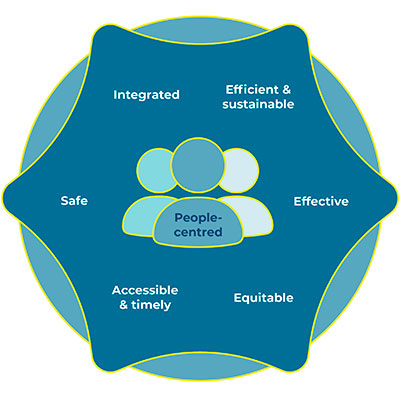
The Alberta Quality Dimensions for Health offer a lens through which people’s experience in the health system can be viewed. Our Framework for an Integrated People-centred Health System includes the enablers and shared responsibilities that create the conditions for these experiences to be realized. Our framework summary is available online now.
CPPA is a leading authority on professional accountability in healthcare. Dr. Cooper, president of CPPA, is internationally recognized for his work in professionalism, healthcare culture, and patient safety.
10 tips for a strong Patient Experience Award submission
Has your team implemented an initiative that made a positive difference to patient experience? Health Quality Alberta invites submissions to the 2027 Patient Experience Awards starting Oct. 1.
The awards recognize the great work of teams across the province that have improved how patients and families access or receive healthcare services. Patient advisors and staff with expertise in health system improvement judge the submissions. Winners receive a high-quality professional video showcasing their project, a $2,000 education grant, an etched-glass trophy, and personalized certificates for their team members. Meet past recipients.
A well-prepared submission that fully addresses the award criteria can give your project the best chance of succeeding. The following tips can help.
1. Don’t apply before you’ve implemented your initiative. The award criteria require evidence of successful implementation. Your submission should describe how you know the changes you made measurably improved the experiences of patients and families.
2. Get familiar with how we define ‘patient experience’ and quality. Read the user guide ahead of time, which defines the four domains of patient experience. Understand the lens Health Quality Alberta uses to assess quality by reading the Alberta Quality Dimensions for Health.
3.Review the criteria. The user guide describes the criteria, including point for point what the judges will look for in a submission. Use that information to structure your submission.
4. Clearly describe how the patient/family voice directed or influenced the work. Explain how you knew patients wanted or needed the changes you made, and how you included the patient voice throughout – or if not, why not.
5. Be descriptive. You have only 500 words to summarize your initiative. Avoid jargon and try to paint a picture in the judges’ minds of the change you made and why you made it. If the judges can’t fully understand your project, they can’t assess it properly. Provide facts and examples.
6. Include an objective statement of support. Ensure at least one of your two statements is from a patient who experienced the change you made. Only one of your statements can come from a patient advisor on your team, if you had one. If the patient population you serve makes it difficult to obtain statements of support, contact us at info@hqa.ca to talk about options.
7. Read the exemplars to see successful submissions from the past.Review a few of them for a well-rounded picture of how different teams have followed the criteria to describe their initiatives.
8. Think broadly about your evidence of success. Consider a range of evidence, such as quantitative and qualitative metrics and anecdotal lived experience.
9. Apply early. The best submissions rarely come together at the last minute. Give yourself enough time to review and confirm your submission meets all requirements. By starting early, you’ll also have time to contact us with any questions and make any needed revisions by the deadline. Before your submission is accepted, we review it for eligibility and completeness, and this sometimes requires applicants to revise and resubmit. Late submissions cannot be accepted.
10. Contact at us if you have questions. If you’re unsure about any aspect of the criteria, including the eligibility of your project, your success measures, or your items of support, reach out. We’re here to help and can answer your questions. Contact us at info@hqa.ca.
Learn more about the Patient Experience Awards, including eligibility and deadlines, here.
Health Quality Alberta seeks input about continuing care workforce experiences
To gain a more complete picture of the state of continuing care in the province, it is essential to also understand the perspectives of the workforce providing leadership and care within these homes and programs.
Health Quality Alberta is launching an anonymous online survey for Alberta’s continuing care workforce to better understand overall experiences. The survey will focus on a few key areas such as: job satisfaction, well-being, work engagement, and safety.
For over a decade, Health Quality Alberta has collected the experiences of home and community care clients and residents and family members in continuing care homes type A and B. The information collected and analyzed gives voice to residents and clients receiving care as well as their family members.
Results are shared with each site, organization, government, operators, and leaders in continuing care. Ultimately, these results are intended to guide reflection and assist in identifying both strengths and quality improvement opportunities.
The results from this survey will be provided to leaders and policy makers to establish a benchmark and determine what is working well and where there are opportunities for improvement.
New enablers and shared responsibilities can bring the quality dimensions into everyday practice
(August 13, 2026). Health Quality Alberta has published new resources to support the successful uptake of the Alberta Quality Dimensions for Health. The dimensions, which provide a common definition of health quality for Alberta, were updated last year. They include people-centred, integrated, safe, accessible and timely, effective, efficient and sustainable, and equitable.
The enablers and shared responsibilities shared today were developed with feedback from system partners. They are the supporting conditions and behaviours that can bring the dimensions into everyday practice. Enablers speak to the wider context of a setting or system; shared responsibilities are about the way people show up with and for one another.
“As the one organization that works across all parts of the health system, we see an opportunity to help ensure everyone is on the same page when it comes to quality,” said Carmella Steinke, chief executive officer of Health Quality Alberta. “The Alberta Quality Dimensions for Health is a valued resource among system partners. The enablers and shared responsibilities provide guidance on how to achieve the quality of care the dimensions describe.”
Together, the quality dimensions, enablers, and shared responsibilities offer a framework for improvement in line with leading thinking about integrated people-centred care. The resources can be used at system, organizational, and care-delivery levels, informing policy, strategy, and design for the system and giving organizations and teams a common language that shifts thinking and practice.
2026 Patient Experience Award winners demonstrate the value of patient input for creating solutions
Health Quality Alberta today celebrates four initiatives for improving the patient and family experience across a range of services – including peer support, assessment of children’s health and disability, cultural support and advocacy, and resources to support patients after receiving a diagnosis.
“Each of this year’s recipients shows how patient input can drive improvement,” says Allyson Goyette, Chair of Health Quality Alberta’s Patient and Family Advisory Committee. “Each team involved patients and families in designing solutions that improved how the services were accessed or received. We congratulate them for this great work.”
The Patient Experience Awards program was established by Health Quality Alberta and its Patient and Family Advisory Committee in 2015 to recognize and spread awareness of initiatives that improve the patient’s overall experience. Aspects of patient experience include relationships, and how patients and families are treated; delivery of services that are person-centred, safe, timely, and effective; planning of services, such that patients and families are treated as partners; and a clean, safe, and inviting physical environment that supports healing and the efficient delivery of services.
“Good work is done every day in the healthcare system by teams dedicated to listening to patients and delivering excellent care,” says Dr. David Zygun, Chief Executive Officer. “And we know that recognizing this work and holding them up as examples can help good ideas to scale and spread. We’re proud to celebrate these teams.”
Join the Chiropractic Association of Alberta and other leading organizations who have committed to building a just culture for their patients’ safety
Why a just culture is important
A just culture is an environment of trust in which healthcare workers are supported and treated fairly when patient care does not go as intended. In this environment, people speak up to prevent incidents and to report when something could go wrong. A just culture, effective reporting systems, and the will to learn and improve, all contribute to a safe culture. In a safe culture, organizations balance proactive and reactive strategies so everyone who receives and provides care is kept from all forms of preventable harm.
Strengthening a just culture starts with an organizational commitment supported by policies and procedures. Find out how the Chiropractic Association of Alberta (CAA) is creating a just culture.
Just culture in chiropractic care
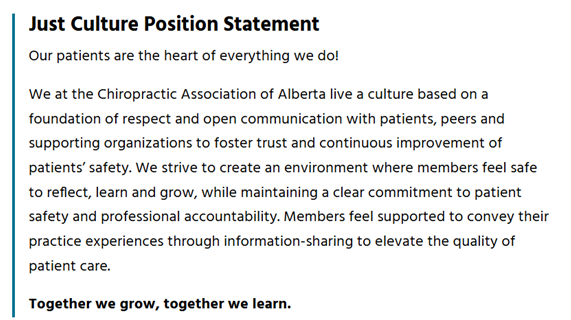
Cecilia Bloxom, CEO of CAA, along with her Board of Directors, led the development of a Just Culture Position Statement. This necessary first step demonstrates the CAA’s commitment to safety, learning, and shared accountability. Working with Dr. Ward Flemons, vice-chair of health analytics, quality and safety in the Department of Medicine and professor of medicine at the University of Calgary, and Deborah E. Prowse, KC, a patient safety lived-experience advocate, the statement was developed at a board retreat as part of their strategic plan highlighting a culture of safety and innovation driving evidence-based care.
“With this foundation in place, CAA can next set the structures needed to implement a reporting and learning system. How we respond to a reporting and learning environment will continue to nurture CAA’s just and safe culture,” says Cecilia.
“Going forward, CAA’s vision is to embed safety, evidence, and sustainability into everyday practice by promoting outcome-based care and encouraging collaboration with other health professionals. By leveraging academic partnerships and innovative initiatives, chiropractors will build public trust, influence health policy, and position chiropractors as essential contributors to a resilient healthcare system,” adds Cecilia.
(Left to right) Front row: Dr. Jacqueline Boyd (board chair) Ms. Cecilia Bloxom (CEO), Dr. Anna Winner, Dr. Elaine Screaton (vice-chair), Dr. Mitch Toffan, Dr. Arif Karmali, Dr. Kelly Fleck (past chair), and Back row: Dr. Kara Otuomagie, Dr. Rebecca-Jane McAllister, Dr. Michael Heinzlmeir, Dr. Ron Steingart
Health Quality Alberta resources
Show your commitment by viewing our resources to steadily create and strengthen a safe and just culture:
Review or draft your organization’s just culture principles.
Promote the principles and encourage your team to take this short, free Just culture e-learning course so they understand why a just culture is important.
With a mandate to improve patient safety, person-centred care, and health service quality on a province-wide basis, the Health Quality Alberta team was excited to participate in the 2025 Canadian Patient Safety Week.
Canadian Patient Safety Week is an annual week-long campaign led by Healthcare Excellence Canada that brings people together around a shared goal: making healthcare safer for everyone. The 2025 theme was “All Voices for Safer Care” and ran from October 27-31.
Taking inspiration from Healthcare Excellence Canada’s I see safer care in action when … campaign activity, we shared our own version on our LinkedIn channel throughout the week. “This was an opportunity to highlight Health Quality Alberta’s commitment to improving patient safety by showcasing the many resources and people bringing it to life,” says Ioana Popescu, Lead, Health System Improvement.
New Board Chair and Chief Executive Officer announcements at Health Quality Alberta
Angus Watt has been designated by Primary and Preventative Health Services Minister Adriana LaGrange as Chair of the Health Quality Alberta Board of Directors, effective October 1, 2025. Mr. Watt served on the executive committee since joining the Board in June 2024 and has been Acting Chair since August 2025.
Mr. Watt is a senior wealth advisor, National Bank Financial, and founding partner of the Angus Watt Advisory Group. For more than 40 years he has served Albertans as a community builder, volunteer, and philanthropist across multiple sectors, including health and social services.
In 2023, he was inducted into the Alberta Order of Excellence and as a laureate into the Junior Achievement Business Hall of Fame. He is a past recipient of the “Paul Harris Fellow” awarded by the Rotary Club of Canada. In 2012, Mr. Watt received the Queen Elizabeth II Diamond Jubilee Medal, and in 2023, he received the Queen Elizabeth Platinum Jubilee Medal.
Mr. Watt’s considerable history leading and supporting many causes, as well as his long career as a respected senior business leader, are an asset to Health Quality Alberta as the organization grows its contributions to health system improvement.
Permanent Chief Executive Officer named
On behalf of the Board of Directors, Mr. Watt is pleased to announce the appointment of Dr. David Zygun as Chief Executive Officer for Health Quality Alberta, effective October 1, 2025. Dr. Zygun’s appointment follows a formal executive search and selection process. He has been Acting Chief Executive Officer since May 2025.
“Dr. Zygun has extensive clinical, academic, and leadership experience in Alberta’s healthcare system. In addition to his many accomplishments, he brings a passion for improving healthcare quality, listening to patients, and collaborating with healthcare partners that effectively positions him to help Health Quality Alberta deliver on its mandate,” says Mr. Watt.
“During his time serving as Acting CEO, Dr. Zygun has demonstrated his expertise by leading the organization through critical conversations with key healthcare partners on the role of Health Quality Alberta in the refocused healthcare system in Alberta, the launch of the Alberta Quality Dimensions for Health to guide system improvement, as well as the introduction of the new Health Quality Alberta name,” adds Mr. Watt.
Dr. Zygun is a neurocritical care physician and was also a professor and past first chair of the Department of Critical Care Medicine at the Faculty of Medicine and Dentistry, University of Alberta. He previously served as the Zone Medical Director for the Edmonton Zone, Alberta Health Services (AHS) and held other leadership roles at AHS including Acting Associate Chief Medical Officer of Strategic Clinical Networks (SCNs), Senior Medical Director of the Critical Care SCN, and Zone Clinical Department Head of Adult Critical Care, Edmonton Zone.
New Board Chair and Chief Executive Officer announcements at Health Quality Alberta
This website uses cookies to help us provide you with better service. Learn more »
This website uses cookies to improve your experience while you navigate through the website. Out of these, the cookies that are categorized as necessary are stored on your browser as they are essential for the working of basic functionalities of the website. We also use third-party cookies that help us analyze and understand how you use this website. These cookies will be stored in your browser only with your consent. You also have the option to opt-out of these cookies. But opting out of some of these cookies may affect your browsing experience.
Necessary cookies are absolutely essential for the website to function properly. These cookies ensure basic functionalities and security features of the website, anonymously.
Cookie
Duration
Description
cookielawinfo-checkbox-analytics
11 months
This cookie is set by GDPR Cookie Consent plugin. The cookie is used to store the user consent for the cookies in the category "Analytics".
cookielawinfo-checkbox-functional
11 months
The cookie is set by GDPR cookie consent to record the user consent for the cookies in the category "Functional".
cookielawinfo-checkbox-necessary
11 months
This cookie is set by GDPR Cookie Consent plugin. The cookies is used to store the user consent for the cookies in the category "Necessary".
cookielawinfo-checkbox-others
11 months
This cookie is set by GDPR Cookie Consent plugin. The cookie is used to store the user consent for the cookies in the category "Other.
cookielawinfo-checkbox-performance
11 months
This cookie is set by GDPR Cookie Consent plugin. The cookie is used to store the user consent for the cookies in the category "Performance".
viewed_cookie_policy
11 months
The cookie is set by the GDPR Cookie Consent plugin and is used to store whether or not user has consented to the use of cookies. It does not store any personal data.
Functional cookies help to perform certain functionalities like sharing the content of the website on social media platforms, collect feedbacks, and other third-party features.
Performance cookies are used to understand and analyze the key performance indexes of the website which helps in delivering a better user experience for the visitors.
Analytical cookies are used to understand how visitors interact with the website. These cookies help provide information on metrics the number of visitors, bounce rate, traffic source, etc.
Advertisement cookies are used to provide visitors with relevant ads and marketing campaigns. These cookies track visitors across websites and collect information to provide customized ads.